
Pīpīwai TrailOn the trail
Bamboo Forest Maui
Last checked 2026-08-16
Wikimedia Commons, Bamboo forest, Pipiwai Trail
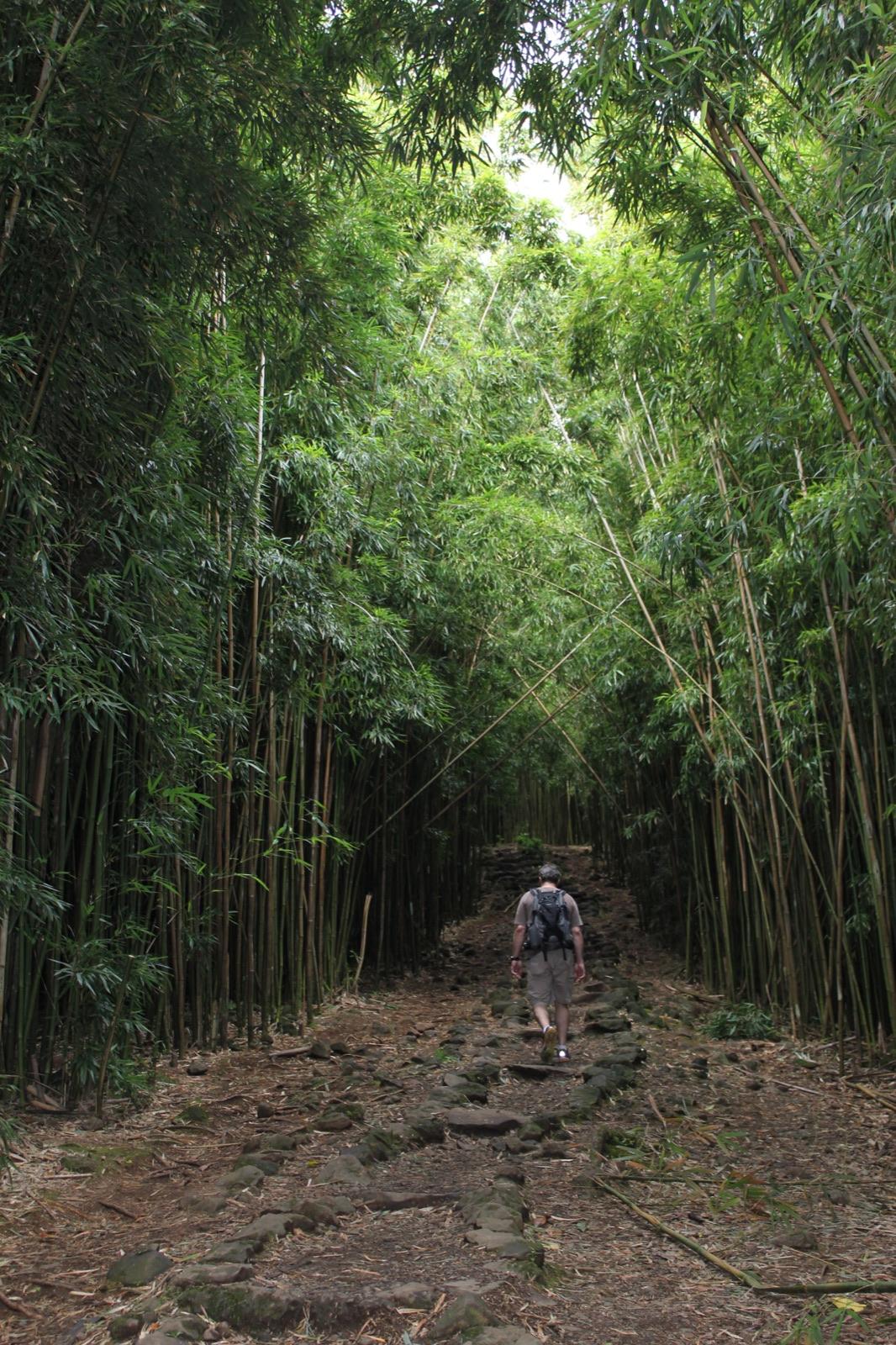
The bamboo starts about 1 mile into the Pīpīwai Trail, right after the bridge and the short flight of steps above it, and runs roughly half a mile on boardwalk. That is the grove in the photograph you have seen: green light, no sky, and a hollow knocking overhead whenever the wind moves. Reaching it takes about 42 minutes from the trailhead. It is the reason most people walk this trail, and it is a different bamboo forest from the one near Twin Falls that shares the search term.
| Question | Answer |
|---|---|
| Where it starts | 1 mile in, just above the bridge |
| How long it runs | Roughly half a mile, most of it boardwalk |
| Time from the trailhead | About 42 minutes at an easy pace |
| Out and back to the bamboo | About 1 hour |
| If you keep going | 1 more mile to Waimoku Falls |
| Underfoot | Boardwalk, wet and smooth |
Where this sits on Pīpīwai
- 1
0.5 mi · First waterfall view
- 2
On this page
Bamboo forest
~1 mi · Boardwalks and footbridges
- 3
2 mi one way · 400 ft falls
Where does the bamboo forest start on the Pīpīwai Trail?
At about 1 mile, and the entry is abrupt enough that you will know. The order is this: the first climb and its stone steps in the opening half mile, Makahiku Overlook at 0.5, the banyan at 0.7, then the bridge over the confluence at 0.9. Immediately across the bridge the trail pitches up a flight of steps, 90 feet of climb in a couple of hundred yards, and at the top of that pitch the bamboo closes over the trail.
From there it runs about half a mile, boardwalk over most of it, with short stretches of dirt where the grove thins. The bamboo does not end so much as open out, and by the two stream crossings at 1.8 miles you are back under mixed forest. Out and back to the grove alone is about 1 hour of walking, and that is the version to take if the group is tired or the light is going.
Which Maui bamboo forest do you mean?
There are two, they are two hours apart, and searching for one will hand you photographs of the other. The famous boardwalk shot, the one with green light and a straight corridor of stalks, is this grove on the Pīpīwai Trail in the Kīpahulu District of Haleakalā National Park, 12 miles past Hāna at the far end of the highway.
The other one is in the Naʻiliʻilihaele drainage near Twin Falls, around mile marker 6 to 7 on the Hāna Highway, less than an hour from Kahului. It is much easier to reach, which is why blogs and social posts push it, and that is where the trouble starts. The route in crosses private and state land without a public trail easement, so people hiking it are frequently trespassing. There is no boardwalk, no maintained tread, and no signage. It involves stream crossings in a flood-prone gorge, unroped scrambles beside waterfalls, and it has produced serious injuries and helicopter rescues.
If you want the walk in the photograph, on a maintained trail with rangers, restrooms, and a park entrance, drive to Kīpahulu. The Twin Falls bamboo is not a closer version of this place, and the Pīpīwai grove is worth the drive it costs.
What is it like inside the bamboo?
Loud, when there is any wind at all. The stalks lean into each other and knock, a dry hollow clacking that starts somewhere out of sight and travels along the grove above your head, and it does not sound like a plant. It sounds like something wooden being stacked. In a gust the whole stand groans and creaks along with it. That noise is the reason people search for this trail, and it is the thing that photographs cannot carry.
The light goes first. Stalks close overhead until the sky is gone and what reaches the boardwalk is filtered green, low and even, with no direct sun anywhere. It is noticeably cooler than the open trail below, and the air goes still and humid at the same time. Sound from outside the grove drops away. Groups get quiet in here without being asked, and then get loud again at the far end.
Underfoot it is boardwalk, wet and smooth. Look up and along rather than only ahead. The stalks run dead straight for forty or fifty feet before the tops bend, and the whole corridor lines up when you stand in the middle of the boardwalk.
Why is there a boardwalk through the bamboo?
Because the mud used to pull shoes off. This stretch sits under a canopy that never lets the ground dry, on a grade too gentle to drain, and before the planks went in it was a churned trough that swallowed footwear and widened every year as people skirted the worst of it. The boardwalk protects the grove and the trail as much as your feet.
The planks come with their own problem. They are smooth timber, permanently wet, and there is no sun in here to dry them. A worn sole finds nothing to grip, which is where many of the falls on this trail happen. Going down is worse than coming up, on tired legs at the end of the day.
Is bamboo native to Hawaiʻi?
No. Bamboo did not evolve in these islands. Polynesian voyagers carried ʻohe here in their canoes and used the hollow culms for water containers, irrigation, fire tools, and the ʻohe hanu ihu, the nose flute played by breathing across a hole rather than blowing into it. Later ships brought other species, which is why groves now stand all over the island. The stand on this trail was brought here, and it is a grass rather than a tree, which is why an individual stalk reaches full height in a season and why the whole grove is one connected organism underground.
The species usually named in this context is Schizostachyum glaucifolium, native further south in the Pacific. What matters on the walk is that the grove is spreading. Bamboo shades out everything beneath it, and the native forest at the edges of this stand is losing ground, which is why the park keeps people on the boardwalk.
When is the best time of day for the bamboo forest?
Mid-morning, roughly nine to eleven. The sun is high enough to push light down through the canopy and give you that even green glow, and it is before the afternoon cloud arrives and flattens everything to grey. Early enough that the trail is quiet, too, and this is a place worth having to yourself for a few minutes.
Two caveats. Mosquitoes are worst right here, because the air is still and the ground stays wet, and they find you the moment you stop to take a photograph. Put repellent on in the parking lot rather than digging for it at 1 mile. And the boardwalk is at its slickest after rain, which in Kīpahulu means most days, so a bright morning does not mean dry planks.
Questions
- Where is the bamboo forest on the Pipiwai Trail?
- About 1 mile in, immediately past the bridge and the short flight of steps above it, roughly 42 minutes from the trailhead. It runs about half a mile, mostly on boardwalk.
- How long does it take to hike to the bamboo forest in Maui?
- About 30 minutes each way, so 1 hour out and back. Continuing to Waimoku Falls makes it 4 miles and 2.5 to 3.5 hours.
- Is the bamboo forest on the Pipiwai Trail the same as the Twin Falls bamboo forest?
- No. The boardwalk grove in the photographs is on the Pīpīwai Trail in Kīpahulu, 12 miles past Hāna. The Twin Falls one near mile marker 6 to 7 is unofficial, often involves trespassing, and has produced serious injuries.
- Is the Maui bamboo forest hike hard?
- The grove itself is flat boardwalk. Getting there means the stone steps in the first half mile and the 90 foot pitch above the bridge. Footing is the difficulty here, not distance.
- Can you turn around at the bamboo forest and skip Waimoku Falls?
- Yes, and plenty of people should. The grove is the highlight for most walkers. Waimoku is 1 mile further on with two stream crossings in between.
- Is bamboo native to Maui?
- No. Polynesian voyagers brought ʻohe by canoe and later ships brought other species. Bamboo is a grass, not a tree, and this grove is spreading into native forest.
Sources: https://www.nps.gov/hale/planyourvisit/hiking.htm · https://www.nps.gov/thingstodo/moderate-hike-up-to-bamboo-forest.htm · https://www.nps.gov/hale/planyourvisit/kipahulu.htm · https://en.wikipedia.org/wiki/Schizostachyum_glaucifolium · https://www.alltrails.com/trail/hawaii/maui/waimoku-falls-via-pipiwai-trail